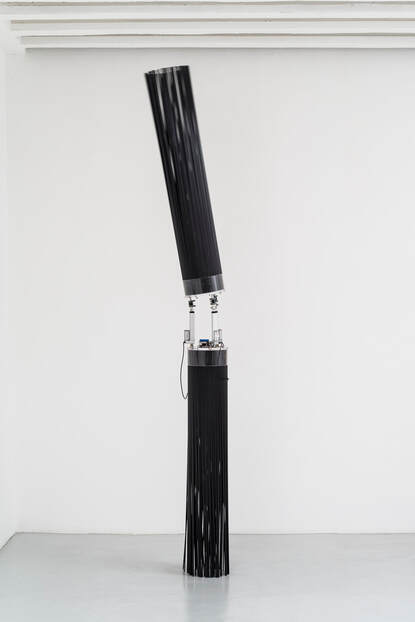
The topic of this machine is Caloro’s attempt to come to terms with sensory balance, derived from genetics. The kinetic sculpture, with an overall height of 3.60 meters and a diameter of 30 cm, consists of a lower part, the base, as well as an upper part, which Caloro refers to as an extremity, a fact that already invites a comparison with the human body. These two components are composed of carbon fiber rods, and are linked by a middle part of Plexiglas. In this transparent tube there are two motors and an electronic control board, which work together to make the upper extremity tilt. Further material contributing to this are the characters of two of Caloro’s genes that have been stored on the control board. These two genes, Apaf1 and Bcl2, are what give the sculpture its title; they are significant for the development of the inner ear as an organ of balance, the malfunction of which may cause dizziness. With this sculpture, the interest in the relationship between man and machine that runs though Caloro’s work is also present in the perception, which has already been filtered by our expectations. It leads us almost automatically to the question of why the machine acts this way and not in another way—a question we also ask when we wish to gain an understanding of our human counterparts.
2012
Apaf1_Bcl2