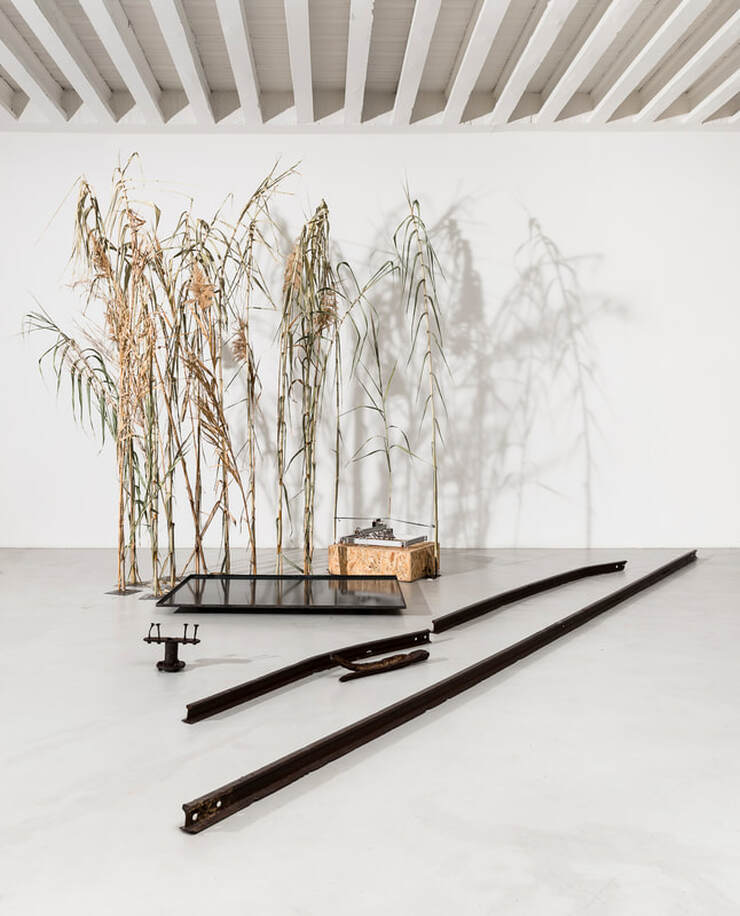
The performance work Autarchic Iron was generated from a reflection on the relationship between nature and industry affecting the Lazio coast near Torre Flavia; due to the rich ironsand deposits, the area was in the past exploited for the extraction of the metal. Condensed in its title is the short circuit established between a given natural presence, iron, and its economic consequence, autarchy, paired in an ambivalent relationship that simultaneously generates and destroys. In creating his work, the artist Caloro observed the territory as would an archaeologist bringing to light a page of history written in the very components of the soil. In fact, the area of Torre Flavia is rich in iron due to the quartz sand formed largely of magnetite. An iron industry began to develop in this area the day after June 10, 1940, when Italy officially entered the Second World War and needed to adapt its industrial production to the new circumstances, above all by increasing the production of iron necessary to feed the insatiable war industry. Thus, in 1940, because of their ironsand deposits, the coasts of the Sardinia, Lazio and Puglia attained autarky. It was in this context that the engineer Giovanni Liguori invented a machine – called a “rapina” and built by Breda – able to separate sand and ferrite, and easily deployable in individual or multiple units. It was a revolutionary solution, since the sorting and extraction of iron from the beach sand were difficult procedures and involved an industrial process that was both extremely costly and vulnerable to risky variables such as storm surges. The engine of Liguori’s machine was the arms of men, women and children who sorted and extracted the iron with shovels and spades, and then delivered it to the trolleys for transport. This procedure continued in Torre Flavia until the 1950s, though little now remains of the industrial plants of the Società Terni. Drawing inspiration from this historical episode, Caloro’s work utilizes four sections of rusty rail tracks the lone elements to survive of the old Torre Flavia industrial plant that served to move the trolleys loaded with iron ore extracted from the sand. The heavy presence of iron in the rails is contrasted by the artist with the lightness of ten marsh reeds positioned around a steaming iron basin. The installation highlights the transformation of a natural area into an industrial one, and is completed by the multi-media performance that attempts to convey the experience of precarious self-sufficiency of the industrialization of the beach, questioning the meaning of autarchy in relation to the complexity of the territory.
2019-20
Autarchic Iron