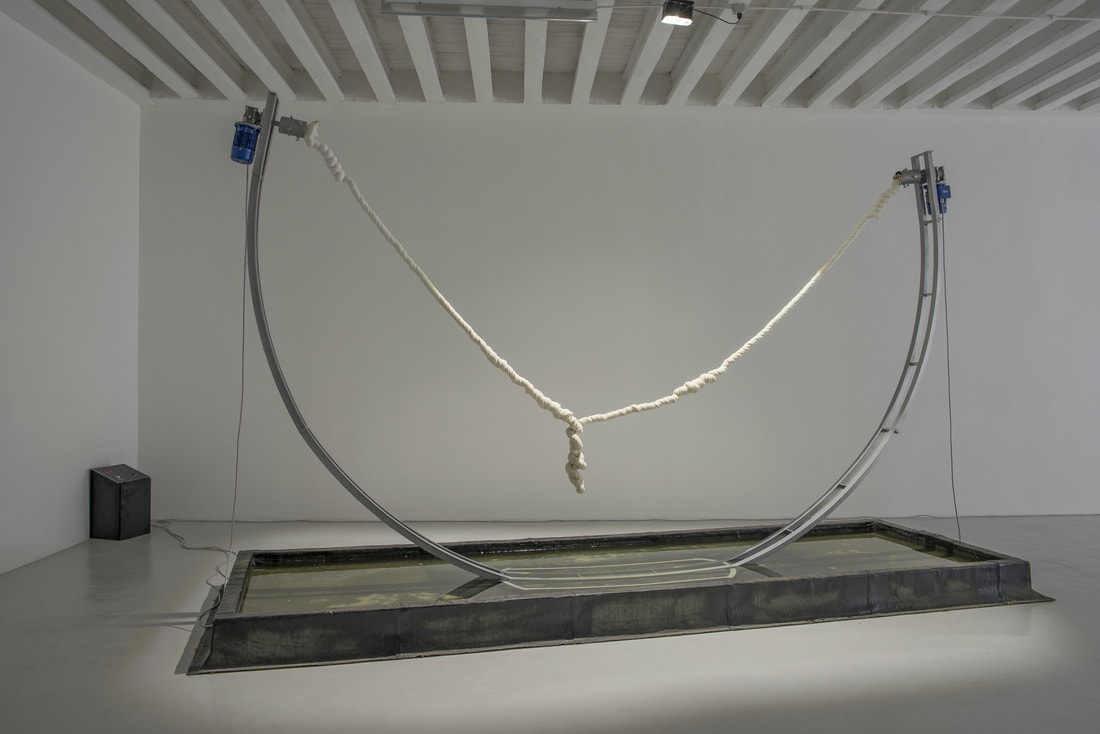
A scythe-shaped aluminium arch 3 metres high and 5 metres wide is set on the floor with the two ends pointing upwards. Two electric motors are installed on the tips, to wring and unroll a strip of cloth 15 metres long. At the bottom of the arch there is a container full of water. The cloth gets soaked in water, is wrung by the motors and after being unrolled, drops back into the water. This process of rolling and unrolling is repeated regularly. The device recalls the machines that test the resistance of products, going through the same actions in a loop pattern.
This work and the resulting associations regard our own being: a reflection on how our life is conditioned by measure, by the measurable, by systems of measurement and by measuring. But if there is a measure, there is also an external measure, something measureless extending to that which is not measurable: the boundless.
Starting from his reflections on the relationship between man and machines, on materialism and the repercussions on our way of life, the work raises the issue of the difference between a living organism with its goals and a type of behaviour to achieve them, and a machine without its own goals just like the “rag wringer”. The work is a critique on the “cage” of day-to-day life in which we are confined with the constant repetition of rhythms alternating between opposite poles, actions repeated in an identical way and with a constant movement, subject to the pressure of never being able to stop and with a constant struggle to maintain balance and stability. In the world of work, we are forced to compete with machines, their programmed rhythms and their predictability.