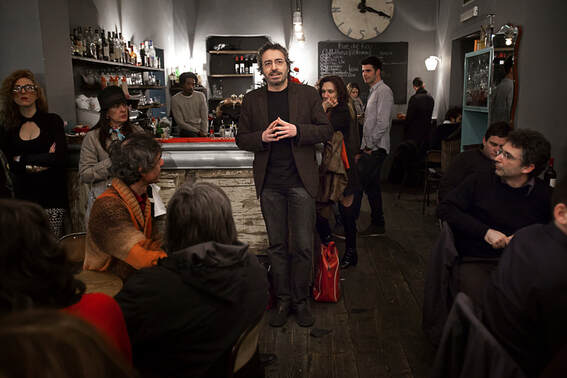
Carlo Caloro makes a theme of the persistent gathering of information about us that no longer provides protection by separating what is public from what is our private lives. Points cards when we shop, data that incur when using the computer that is limitlessly connected to the Internet, as well as connections when we telephone, make us to monitored beings, from which profiles of our actions and movements may be compiled. Via the collected traces of our consumer behavior, personal details become commercial goods, information from which an image of our persons may be constructed. The possibility of DNA-identifications from the minutest traces we leave behind each day the moment we extend a hand or drink something enables a further decoding of our most personal details. At the same time, however, Caloro questions whether all of this, in particular the information having to do with our genes, which is easily obtainable through spying, may indeed reflect our personality On the basis of experimentally gathered data of traces of an unknown individual on a plastic cup that was found, Caloro had an image made from characteristics that it was possible to glean from this. Does this already constitute a reconstruction of our personality? In a performance, an actor personifies these characteristics in a real context, a casual celebration with all its unpredictable encounters and the resulting interactions that come about among people meeting one another. The random, spontaneous questions and conversation topics of the guests dash against the texts of the actor, which had been pre-formulated as hypothetical thoughts, the resulting elements of conversation stemming from the knowledge of his presumed genetically predetermined personality. It is up to the performance visitor to experience the consequences of the social interaction and draw his or her conclusions from it.
Lumpenwringer - Kinetic Sculptur, 2013 -2014
A scythe-shaped aluminium arch 3 metres high and 5 metres wide is set on the floor with the two ends pointing upwards. Two electric motors are installed on the tips, to wring and unroll a strip of cloth 15 metres long. At the bottom of the arch there is a container full of water. The cloth gets soaked in water, is wrung by the motors and after being unrolled, drops back into the water. This process of rolling and unrolling is repeated regularly. The device recalls the machines that test the resistance of products, going through the same actions in a loop pattern. This work and the resulting associations regard our own being, and Caloro reflects on how our life is conditioned by measure, by the measurable, by systems of measurement and by measuring. This is Carlo Caloro’s stimulating conclusion: “But if there is a measure, there is also and an external measure, something measureless extending to that which is not measurable: the boundless”. Starting from his reflections on the relationship between man and machines, on materialism and the repercussions on our way of life, Caloro raises the issue of the difference between a living organism with its goals and a type of behaviour to achieve them, and a machine without its own goals just like the “rag wringer”. The work is a critique on the “cage” of day-to-day life in which we are confined with the constant repetition of rhythms alternating between opposite poles, actions repeated in an identical way and with a constant movement, subject to the pressure of never being able to stop and with a constant struggle to maintain balance and stability. In the world of work, we are forced to compete with machines, their programmed rhythms and their predictability.