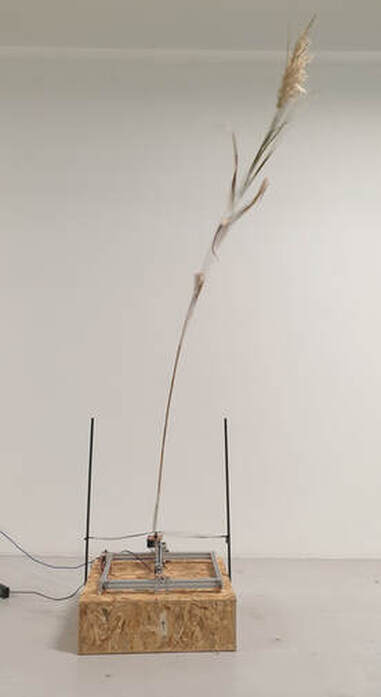
environmental installation, 2019
With the installation work A Small Root for a Plant in Space, a Great Root for Terrestrial Flora, Carlo Caloro imagines the future of plants in an approaching era when human beings colonize other planets. Much of current scientific research is directed towards a study of the capacity for resilience of our species in environments hostile to life and lacking the atmospheric characteristics of planet Earth, in order to test and prepare the human body to reach extra-terrestrial destinations. On this anticipated, suspended journey that projects the destiny of mankind into unknown scenarios on other planets, plants will be substantial allies, the artist reminds us, necessary travel companions because of their vital, nourishing function. Not without irony, in the installation it is the plant – in this case a cane − that is the protagonist, placed on a rudimentary treadmill built by the artist, as if it were engaged in a daily exercise routine, a device that has been adjusted to support the slender silhouette of the plant. The mechanism of the structure is repurposed to simulate phototropism, that is, the movement that leads the plant to bend towards directional light sources, enabling the staging of an automatic action to emulate the natural flexion of plants that normally follows the sun from East to West. Just as human beings are subjected to rigorous training to keep the body under control in view of extreme living conditions, so in the caprice of the work the plant is personified in gymnastic guise, enjoying a space dedicated to exercise in order to stay fit and reduce stress. The ambivalent jest hidden within Caloro’s installation, between the irony of the personification of the plant and the extreme distortion of tasks in the Man/Nature relationship seems to invite reflection on the role of the human sciences and their function with respect to the decentralization of the human species, which imposes its own measures on all aspects of nature. Uniting forces in the hypothetical journey to new planets, the artist projects the repetition of an anthropocentric system, whose gears move by means of technology that often crushes nature under its boot.
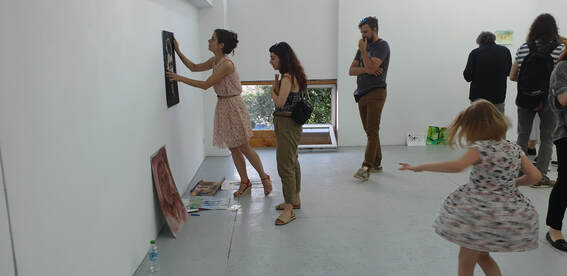
The project Five (alleged) artists focuses on artists and their genesis in terms of “being” and “doing” so as to reflect on the intrinsic, or “biological”, origins of an individual’s aristic process and their encounter with the social dynamics of the art system. Rivers of ink have been spilled regarding the relationship between a work of art and the public who recognize it as such, as well as about the mystery which sanctions the birth of an artist and their entrance into history books, yet these subjects remain elusive and difficult to define. Departing from these reflections, the artist Carlo Caloro - called to think of a project for the A + Project Space in Cluj-Napoca in collaboration with artQ13 in Rome and curated by Giuliana Benassi - has devised to transform the space into a place of living experimentation. He in turn invited five young artists at the beginning of their career to dispay their own works to the public, who will be able to interact in the selection and staging of the exhibition. The name Five (alleged) artists wants to escape with subtle irony from a specific definition of “artist”, in order to stimulate and provoke the public to actively participate in the recognition process. In this game between observer and observed the concept of showcasing is exacerbted, in reference to two different circumstances: the tangible one concerning the work of art and the elusory one of being an artist. In fact the young artists - Daniela Ciolomic, Augusta Cuc, Melitta Erzsébet Karácsony, Christine Ribstein, Maria Stoica - are called to bring their pictorial and graphic